Appliance heroes vs. hogs

While some appliances have slimmed down, others still overindulge. Here’s the truth about the current coursing through your home’s devices.

Recent news

Title
Appliance heroes vs. hogs
/sites/default/files/styles/focal_point_card_image_510x430_/public/images/news/2026-feb-tcp-appliance-arguments-hero-1900x900.2.jpg?h=57f1ee14&itok=irQb3uSu
/sites/default/files/styles/news_gallery_images_1037x561/public/images/inpage/2026-feb-tcp-appliance-arguments-hero-1900x900.2.jpg?h=57f1ee14&itok=fVuMniI7

While some appliances have slimmed down, others still overindulge. Here’s the truth about the current coursing through your home’s devices

By Sharon Jayson

Chris and Michelle Birnbaum live about 6 miles outside Giddings in Lee County with two adult children in the 2,000-square-foot “barndominium” home they built in 2015. The metal barn-style buildings are known for open floor plans, affordable construction costs and energy efficiency. 

What's eating your watts?
Click the image above to get a pdf that compares how much electricity common household devices use and what that means in annual cost for a typical Bluebonnet Electric Cooperative member.

When it comes to appliance purchases for their four bedroom, two-and-a-half-bathroom home, Chris looks closely at how much electricity each appliance will use. “I look at Energy Star labels on everything we buy,” he said, referring to the blue-and-white stickers on appliances that meet energy efficiency guidelines set by the federal government.

APPLIANCE ARGUMENTS

THE FUTURE OF APPLIANCES

Most buyers look at an appliance’s price, size, brand and performance before they factor in energy efficiency and features, according to Bluebonnet Electric Cooperative-area retailers and national consumer research groups. 

Every appliance uses electricity. But some are energy hogs that eat more than their share of your electric bill. Others are electricity heroes that use less power or can help you cut your electric use. 

Because our summers are hotter, Texas homes use at least 25% more electricity than the national average, according to a U.S. Energy Information Administration report. The biggest power hog in your house is the air-conditioning and heating, or HVAC, system. It’s a pain in your wallet in the summer and a strain on the electric grid on winter’s coldest days. 

Appliance hogA typical 2,000-square-foot home uses an average of about 1,200 kilowatt-hours (kWh) per month. That amount of electricity costs about $115 a month, or $1,381 a year. That amount does not include additional charges that appear on the bill. Of that, an all-electric HVAC system can eat up an estimated 40% to 50% — from $456 to $690 — of that annual cost for electricity, according to consumer sites, state and federal sources, and other Texas utilities. 

The energy efficiency of your system and house are big factors, especially during summer’s triple-digit heat. Window AC units may be worse: An older, inefficient unit could use 1,300 kWh in just three hot Texas months. A newer energy-efficient window unit could use 30% to 50% less electricity.

Next on the list of power hogs are older swimming pool pumps, your home electric water heater, refrigerator/freezer, clothes dryer, range and oven, then the dishwasher. The clothes washer is ranked last, but its power use varies depending on the type of washer and its age. How often you use most of these appliances is another variable — except for the refrigerator/freezer, which is always running. 

Replacing appliances such as old water heaters, refrigerators or single-speed pool pumps with newer, more energy-efficient versions can have a significant impact on your electricity costs.

Dryers, long considered high on the energy hog list, have improved in the last decade with sensors that control heat and cycle time, as well as some that have their own heat-pump technology. How often you use a dryer and the size of the loads you toss into it also impact the electric bill.

Appliance heroThen there are energy heroes. Some are familiar appliances like the microwave oven, which uses less than a third of the electricity of a standard oven for small meals, or a newer dishwasher, which can use less water and electricity than washing dishes by hand. The energy-saving mini-split style air conditioner/heater can replace a window AC unit. It costs less to operate and can circulate air efficiently even when it’s not cooling or heating. The trusty ceiling fan, operated at a medium speed for about six hours a day, uses 150 to 200 kWh a year (about $17). It cools you, not your room, and can help you save 10% of the electricity your HVAC would use.

Old energy hogs have slimmed down in recent years. A newer laptop uses less power than a desktop computer, and today’s gaming consoles cost pennies when in standby mode, compared with their older “always-on” counterparts. 

On the smaller side, the electric kettle is faster and more efficient than heating water on the stovetop, and a multicooker (the Instant Pot is a popular one) uses much less energy than the oven or stove, cooking slowly with less electricity.

Then there are energy-saving devices: A smart thermostat can reduce HVAC consumption by as much as 15%, switching to all-LED lighting can take a big bite out of your electric bill, and smart plugs and strips let you schedule or remotely turn off electronics or groups of plugged-in devices.

Sources: U.S. Energy Information Administration (eia.gov); EIA Residential Energy Consumption Survey; energystar.gov; U.S. Department of Energy (energy.gov); 
federalregister.gov; bluebonnet.coop, consumerreports.org; Lawrence Berkeley National Laboratory standby load studies; ecoflow.com; howstuffworks.com; energysage.com; 
airconditionerlab.com; consumer, manufacturer, retailer and utility websites

APPLIANCE INSIGHTS & TIPS

Appliances made in 2001 or earlier can use 40%–50% more electricity than new, more efficient models. Appliances that are more than 10 years old may use 28%–36% more electricity.

Seals, motors and insulation degrade over time, increasing electricity use.

Always-on devices continue to draw power: Refrigerators, pool pumps, desktop computers, gaming consoles, routers and digital displays.

Appliances with the greatest leaps in efficiency: HVAC systems, refrigerators, water heaters, pool pumps and dryers.

Worst in class: Old refrigerators and outdated HVAC systems (leaky ducts can cost hundreds annually). The Department of Energy has a refrigerator-rating tool on 
energy.gov for year-by-year comparisons.

More tips: Texas PUC’s Power to Save website, www.puc.texas.gov/waystosave. Sources: U.S. Energy Information Administration; U.S. Department of Energy; Energy Star; EPA; Lawrence Berkeley National Lab; EnergySage; NRDC; appliance manufacturers; consumer product testing; Bluebonnet Electric Cooperative residential rates

SALES TAX HOLIDAY

In Texas, an energy-saving incentive is the three-day Energy Star sales tax holiday — scheduled for May 23-25 in 2026 ­— that lets shoppers buy many types of large appliances tax-free. Learn more at here.

Card Teaser
While some appliances have slimmed down, others still overindulge. Here’s the truth about the current coursing through your home’s devices.
Icy weather hits differently in Central Texas

Title
Hard work, high standards, proud journeymen
/sites/default/files/styles/focal_point_card_image_510x430_/public/images/news/2026-feb-apprentice-hero-900x488.jpg?h=e1378572&itok=Jwxo5Cc2
/sites/default/files/styles/news_gallery_images_1037x561/public/images/inpage/2026-feb-apprentice-hero-900x488.jpg?h=e1378572&itok=ArKYe2Lx

Program prepares apprentice lineworkers to keep 13,000 miles of line and 144,000 meters safe and reliable

By Connie Juarez

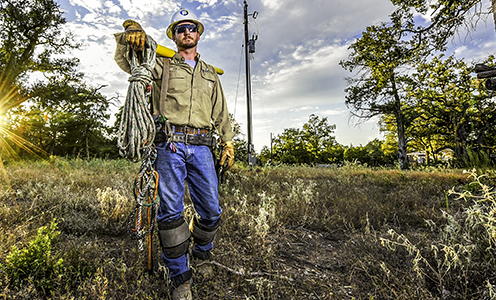
During the last several years, Gunnar Schwartz learned that a lineworker’s job involves more than putting up poles and stringing wire.

“You learn how the control center and substations operate, which helps you see the bigger picture of how everything connects,” Schwartz said. He and 11 other Bluebonnet apprentices learned how to build overhead and underground lines, troubleshoot and restore power during outages, maintain electrical equipment and install and repair meters. 

Beyond the technical skills, the program emphasizes the importance of working with a team and building on others’ experience and strengths. 

Schwartz, who is based in Giddings, is proud to have finished the program, but he is also aware of the expectations that come with the job. 

“Now you’re the one people look to for answers,” the 30-year-old graduate said. “It’s a good feeling, but it comes with more responsibility.”

Schwartz and the other 11 apprentice lineworkers at Bluebonnet Electric Cooperative completed their training in 2025 and joined the co-op’s experienced team of journeyman lineworkers. They work to ensure members have safe, reliable power across the cooperative’s 3,800-square-mile service area.

Completing Bluebonnet’s lineworker apprentice program requires 8,000 hours of on-the-job training and 672 hours of technical instruction, typically requiring four years. Graduates earn certification from the U.S. Department of Labor and are prepared to handle a wide range of fieldwork. 

Joining Schwartz in earning journeyman certification were Huston Burgess, Colton Harris, Cooper Lucherk, Thomas Medrano, Tanner Meuth, Darrin Ott, Ryan Smith, Terry Swonke, Brett Wellmann, Brent Westbrook and Trevor Williams. Lucherk, Swonke, Wellmann and Williams began their careers as lineworker interns in 2021, completing a six-month training program before beginning the apprentice training.

Harris, who is based in Bastrop, said the apprentice program showed him the value of building on a team’s strengths. 

“There are things I’m not as good at as others, and things I’m better at,” he said. “It’s all about working with people and understanding there are many ways to do things.” 

Working to restore power during ice storms gave Harris his most meaningful experiences on the job. “Seeing people’s relief when the lights came back on — that’s what makes it all worth it,” he said.

Reaching journeyman status was important to Harris. “In my family, there’s a long tradition of line work,” he said. “It’s exciting to reach this point, but the journey is just beginning. There is so much more to learn and accomplish.”

Including the 2025 graduating class, 165 apprentices have completed Bluebonnet’s lineworker program since it began in 2004.

Chad Weiss, operations superintendent in Brenham, said the apprentice 
program provides a solid career path that is close to home.

“The majority of the candidates who take part in our program are from Bluebonnet’s service area,” Weiss said. “The program produces skilled, safety-driven, dependable lineworkers who take pride in their work. It’s great to see them building a future in the same communities they’re helping every day.”

The Bluebonnet intern program, which started in 2018, provides six months of technical instruction in line work. To advance into the apprentice program, participants must also obtain power-pole climbing certification and a commercial driver’s license.

To learn more about Bluebonnet’s lineworker internship and apprenticeship programs, visit bluebonnet.coop/careers.

Card Teaser
Program prepares apprentice lineworkers to keep 13,000 miles of line and 144,000 meters safe and reliable

Title
Winter energy-savings tips
/sites/default/files/styles/focal_point_card_image_510x430_/public/images/news/2026-winter-energy-savings-tips-1900x800.1.png?h=804d0c2f&itok=jOmqg60S
/sites/default/files/styles/news_gallery_images_1037x561/public/images/inpage/2026-winter-energy-savings-tips-1900x800.1.png?h=804d0c2f&itok=2-NphwM5

Save electricity and money in cold weather with a few simple suggestions

Cold weather happens, even if it was 80 degrees yesterday. Save electricity and save money with a few simple suggestions from Bluebonnet Electric Cooperative.

LOWER YOUR WATER HEATER TEMPERATURE
The U.S. Department of Energy recommends using the warm setting (120 degrees) on your water heater during the winter months. Plus, consider washing clothes in cold water.

TURN DOWN THE THERMOSTAT
You can save about 3% on your electric bill for every degree you drop the temperature.

SWITCH THE DIRECTION CEILING FANS TURN
If your fan has the capability, make the blades turn clockwise. This pulls cool air toward the ceiling and pushes warm air down.

UPGRADE YOUR FIREPLACE
Add an insert or replace your fireplace with an energy-efficient model.

LET THE SUN IN
Allow natural warmth in through the windows, especially south-facing windows.

USE SPACE HEATERS SELECTIVELY
You can save electricity by heating only the room you are in.

WEAR WARM CLOTHES
It may seem obvious, but putting on an extra sweater and adding wool socks with your slippers will let you lower your thermostat temperature.

LIMIT THE USE OF EXHAUST FANS
They suck out all the indoor air your heater has worked so hard to warm.

ELIMINATE DRAFTS
Cold winter air can sneak in around windows, doors and even electrical outlets. Weather stripping, insulation and insulated curtains can help keep warm air in.

GET MORE TIPS

Download this story as it appeared in Texas Co-op Power magazine

Card Teaser
Save electricity and money in cold weather with a few simple suggestions
News Category
Media contacts

Have questions or comments about news stories or media inquiries?
Please contact:

Will Holford
Manager of Public Affairs
512-332-7955
will.holford@bluebonnet.coop

Alyssa Meinke
Manager of Marketing & Communications 
512-332-7918
alyssa.meinke@bluebonnet.coop

Next Board of Directors' meeting
February 17

The agenda for the Board meeting is updated the Friday before the meeting.

View agendas »