



First responders of the Bluebonnet region




Recent news
Whether you’re buying feed, farming cattle or just flipping a light switch, you’re benefiting from a member-owned cooperative
By Addie Broyles
You know Bluebonnet Electric Cooperative as the company that keeps your lights on. Other cooperatives in the Bluebonnet territory are flipping switches of their own — in ways you might not expect.
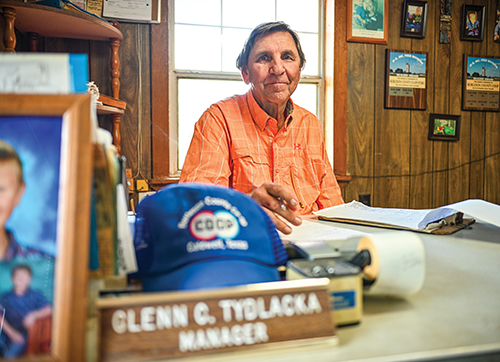
Every time an item is purchased at the Burleson County Co-op Store in Caldwell, it’s not just a sale. It’s a return on the investment its members paid to own a stake in the feed store.
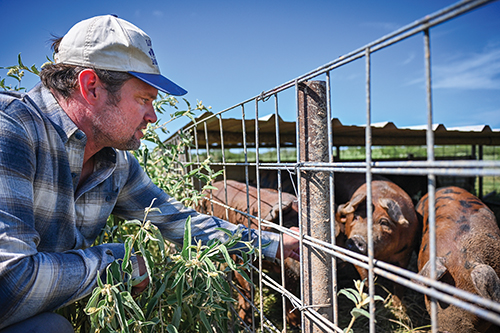
When Aubrey and Perrine Noelke of Belle Vie Farm & Kitchen near Thrall sell their pasture-raised meats at Chaparral Coffee in Lockhart, the sale ripples through the Central Texas Farmers Co-op, where success is shared.
And when members of the Washington County Wildlife Society gather to learn about being good stewards of the wildlife roaming their properties, the cooperative-model group’s wisdom is shared with its more than 350 members.
According to the National Cooperative Business Association, about one in three Americans belong to a cooperative of some kind.
Cooperatives — not just electric cooperatives like Bluebonnet — have been the lifeblood of rural America since the early 1900s, when residents started organizing cooperatively run businesses to help them do everything from negotiating a good price for corn to advocating for fair working conditions.
By definition, a cooperative is a business or organization owned and run by the people who use it. Whether they are farmers, consumers or community organizations, the members call the shots and share the benefits, instead of earning profits for outside investors. Co-ops focus on members’ needs, and each member typically has an equal vote in how the cooperative is run, no matter how much cotton they grow or how much electricity they buy.
That is central to the core principles of all cooperatives, no matter what industry they serve. See the 7 cooperative principles, Page 19.
The roots of co-ops in America date back to the 1750s with the first mutually run insurance groups. In 1844, the Rochdale Pioneers, a group of weavers and artisans in England, founded the first consumer cooperative, establishing the model and principles that guide today’s cooperatives.
The National Cooperative Business Association CLUSA International reports that today, there are approximately 65,000 cooperatively run organizations in the United States.
Of all cooperative businesses, electric cooperatives are among those with the largest membership. Some products and businesses that are household names are run by cooperatives, including Ace Hardware, Do-it-Best Corporation, Blue Diamond Almonds, Sunkist, Land O’Lakes, Ocean Spray, Bob’s Red Mill and REI.
CHS Inc., a Minnesota-based grain and agriculture supply co-op, generates the most revenue of any cooperative in the United States — more than $45 billion annually, according to the National Cooperative Bank.
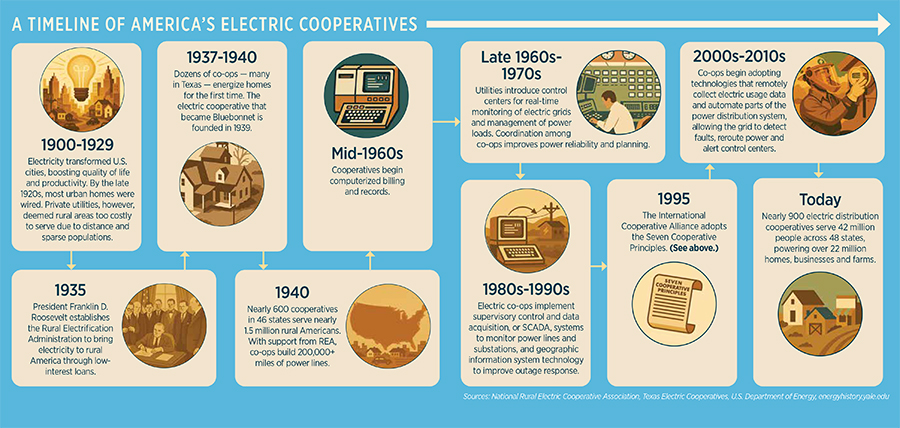
Nearly 900 electric cooperatives operate across 48 states, serving 42 million Americans and powering more than half the nation’s landmass. Electric co-ops maintain over 2.7 million miles of distribution lines nationwide and employ more than half a million people.
In Texas, 76 electric cooperatives serve around 3 million members, according to Texas Electric Cooperatives, an association that represents the interests of the state’s member co-ops. The association advocates for cooperatives at the state and national levels and provides products and services for its members, including the publication of this magazine.
“Texas electric cooperatives have a long history of working to improve the quality of lives of their members and their communities," said Martin Bevins, Texas Electric Cooperative's vice president of communications and member services.
“Across the state and the country co-ops invest in their members' future by providing countless student scholarships for higher education and sponsoring the Government-in-Action Youth Tour which has been providing a once-in-a-lifetime trip to Washington D.C. for co-op youth since 1965. Communities are often safer because of the support co-ops provide to volunteer fire departments and first responders. In fact, two of the seven guiding cooperative principles: Concern for Community and Education, Training and Information are at the center of why co-ops stay focused on programs like these,’’ Bevins said.
Texas is also home to thousands of cooperatives across nearly every sector of the economy, particularly agriculture, according to Christy Lewis, executive director of the Texas Agricultural Cooperative Council. Lewis works with about 250 rural cooperatives across Texas, including those that support farm supply stores, cotton gins and grain elevators.
One of the largest agricultural co-ops in the country is Farmers Cooperative Compress in Lubbock. With approximately 9,300 grower-owners, it is the largest cotton warehousing entity in the world.
Cooperatives like these can help ranchers and farmers negotiate better prices on everything from meat processing to seed. Lewis predicts that cooperatives will play an increasingly critical role in the future of smaller, family-owned farms and ranches across rural Texas.
Rural communities thrive with the help of cooperatively run businesses. The co-ops are often deeply involved in community matters because the residents are also the people making co-op decisions.
Bluebonnet, for example, follows a longstanding tradition of providing more than just electricity to the communities it serves. The cooperative allocates money each year to support community groups and events, schools and scholarships.
In 2025 so far, Bluebonnet has provided 250 cooling fans, 2,160 cases of water and sponsored or made cash donations to 100 events across the service area, including the Lee County Fair in Giddings, the Watermelon Thump in Luling, the Back-to-School Bash in Cedar Creek, the Washington County Fair Shrimp Boil in Brenham and the annual Resource Fair in Manor.
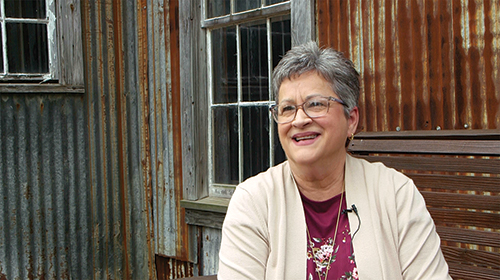
Phyllis Hillhouse can describe how Bluebonnet’s efforts helped her forge a stronger bond with the members of her community.
She manages Zedler Mill, a historic cotton gin along the San Marcos River near Luling. Last year, she worked with Bluebonnet representatives to host an event celebrating the mill’s 100th anniversary. The cooperative set up cooling fans to keep about 800 guests comfortable, and provided an exhibit showing how electricity works.
Being an 18-year member of Bluebonnet has brought Phyllis and her husband, James, other benefits.
When she receives her electric bill, she does a little dance, she said. That’s because the bill is as much as 40% lower than the ones she received in other Texas cities where she has lived. Earlier this summer, she said the bill for their 3,500-square-foot home was less than $150 for each of three consecutive months. “And we keep it cool,” she added.
Hillhouse even had good things to say about the few power outages they have experienced.
“The few times that our electricity has gone out, I get the warning on my phone,” she said of Bluebonnet’s outage text notifications. “They keep me posted. Then, I look out and see trucks troubleshooting. They are Johnny-on-the-spot.”
Whether it’s Bluebonnet, the Burleson County Co-op Store, the Central Texas Farmers Co-op or the Washington County Wildlife Society — or any other type of cooperative — the core principles create connections and shape futures.
That is because cooperatives don’t just serve people — they are people. It is ownership with a heartbeat.
Sources: Texas Electric Cooperatives, Corporation Works, National Cooperative Bank
***
WHAT IS A CO-OP?
Cooperatives are member-owned and democratically run businesses or organizations that return profits through capital credits or dividends. Each member gets one vote — whether farmer, consumer, worker or business — in how their cooperative is run. The U.S. Department of Agriculture names October as National Cooperative Month, launched in 1964 to honor co-ops’ impact on communities and the economy. Nearly one-third of Americans belong to one. The United Nations has identified 2025 as the International Year of Cooperatives.
***
Sarah Beal photo
CENTRAL TEXAS FARMERS CO-OP
- Eight member producers from Hays,
- Caldwell, Blanco, Bastrop, Travis and Williamson counties l Community-supported agriculture model founded in 2016
- Buyers purchase seasonal subscriptions for shares of meat, poultry, vegetables, eggs and cheese from all member farms
- Goods can be purchased weekly at any of the five pickup locations, one of which is Chaparral Coffee in Lockhart
- centraltexasfarmers.com
***
Sarah Beal photo
BURLESON COUNTY CO-OP STORE
- Caldwell, 111 W. Mustang St., about 260 members
- One of the last remaining cooperative feed stores in the Bluebonnet region
- Organized in 1945 by Ben Wolz, who was also a 40-year member of the Bluebonnet Electric Cooperative Board. His son, Lyle, was a Bluebonnet Board member for 30 years
- The farmer-owned cooperative provides everything from feed, fertilizer and seed to veterinary supplies and sporting goods
- $10 one-time membership fee l Members receive a dividend based on their annual purchases
***
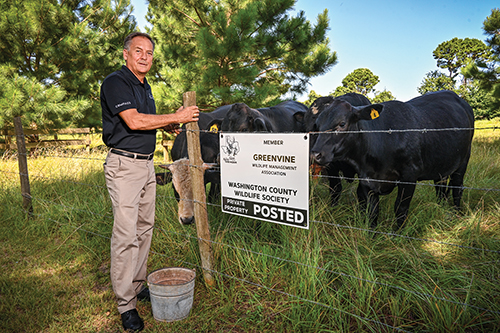
WASHINGTON COUNTY WILDLIFE SOCIETY
- Five wildlife management associations, more than 350 members
- Groups of landowners work cooperatively to find ways to maintain their properties’ habitats and wildlife
- Founded 25 years ago
- The first group of this kind was created in the 1970s to help landowners develop management plans for deer populations threatened by overhunting
- $20-a-year dues; twice yearly meetings with dinner and educational programs from game wardens, biologists and others about land stewardship that extends beyond property lines
***
BLUEBONNET IS A PART OF TEXAS’ POWER LEGACY
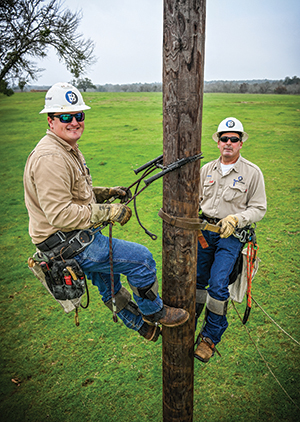
Electric cooperatives like Bluebonnet play a vital role in powering communities, especially in rural areas. In honor of National Cooperative Month, we’re highlighting how your member-owned organization operates on the principles of local governance, service and community investment.
Founded on Aug. 2, 1939, Bluebonnet Electric Cooperative — originally known as the Lower Colorado River Electric Cooperative — was created to bring electricity to rural Central Texas under the Rural Electrification Act signed by President Franklin D. Roosevelt in 1936.
As one of the earliest co-ops in Texas, Bluebonnet quickly expanded access to power in underserved communities. By 1940, the cooperative had 646 miles of line and 1,468 members. In 1965, it was renamed Bluebonnet Electric Cooperative.
Today, Bluebonnet serves more than 142,000 meters across 12,700 miles of power lines in 14 Central Texas counties. Over the past five years, that number has grown by 32%, making Bluebonnet one of the fastest-growing electric cooperatives in the nation.
The co-op prioritizes system reliability, preventive maintenance and long-term infrastructure planning to deliver safe, affordable power. Its electric rates remain among the lowest in Texas, and its member-service commitment continues to meet the needs of a rapidly growing region.
Bluebonnet also supports local communities through grants, scholarships and civic involvement.
***
THE 7 COOPERATIVE PRINCIPLES
These principles were adopted in 1995 by the International Cooperative Alliance, a global organization that supports and promotes cooperatives across all industries. They reflect the core values that define cooperatives: democratic governance, member ownership and a focus on serving members’ needs rather than generating profit.
- Open and voluntary membership: Open to all who can use the services and accept membership responsibilities.
- Democratic member control: Members actively participate in governance and have equal voting rights.
- Members’ economic participation: Members financially support the cooperative in a fair and proportional way based on their use of its services and share in the cooperative’s financial benefits.
- Autonomy and independence: Cooperatives remain self-sufficient, member-controlled organizations. Even when they partner with outside entities, they maintain their independence and identity.
- Education, training and information: Ongoing learning and communication helps members, employees and leaders make informed decisions and support the cooperative’s success.
- Cooperation among cooperatives: Working with other local, regional, national and international cooperatives strengthens services and benefits members and communities.
- Concern for community: Cooperatives are committed to the long-term well-being and development of the communities they serve.
Sources: International Cooperative Alliance, National Rural Electric Cooperative Association
***
MANY KINDS OF COOPERATIVES
From electric utilities and feed stores to coffee shops and cotton gins — cooperatives take many forms. Here are some of the primary types:
UTILITY CO-OPS: Member-owned public utility providers for services like water, electricity or telecommunications.
CONSUMER CO-OPS: Businesses like Burleson County Co-op Store in Caldwell, which lets customers become members and earn a year-end dividend, or companies like REI and Ace Hardware are owned by customer-members.
WORKER CO-OPS: Businesses owned and run by their workers, such as Patchwork Farm in Manor.
INSURANCE CO-OPS: Member-owned mutual insurers serving policyholders, like Nationwide and Farm Bureau Insurance.
HOUSING CO-OPS: Residents pool resources to own and control their buildings or communities, usually in urban areas.
PRODUCER CO-OPS: Producers join to market or process goods, such as the Central Texas Farmers Co-op. Cotton gins and grain elevators are classic examples.
PURCHASING CO-OPS: Individuals, organizations or businesses — like childcare providers or schools — combine buying power to get better prices and terms. Many area schools use co-ops like BuyBoard, TIPS-USA or Texas SmartBuy.
Sources: Cooperation Texas, National Cooperative Business Association
It’s time for Bluebonnet-area barbecue to share the spotlight with its supporting cast, from potato salad to poblano spaghetti
Story by Eric Webb * Photos by Sarah Beal
Picture a plate of barbecue. Maybe you see brisket with peppery bark guarding a glistening streak of fat. Perhaps there’s a shiny link of sausage, the casing ready to snap and reveal the juiciness inside. Don’t forget the beef rib as big as you think your appetite is.
When you’re talking Texas barbecue, meat always gets top billing.
But where would Batman be without Robin, or Brooks without Dunn? Solid co-stars are essential to Texas barbecue, and no trip to the pit would be complete without the supporting cast of side dishes.
Most barbecue joints in the Bluebonnet Electric Cooperative region rely on the classics — potato salad, pinto beans and coleslaw. A few restaurants are shaking things up with a fresh take on side dishes.
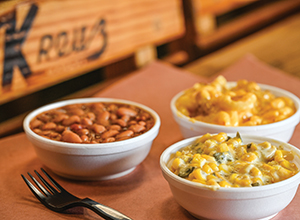
Barbecue pros know that the side of the plate is valuable real estate, where nostalgia and creativity can be equally delicious. We toured the Bluebonnet service area and stopped at more than a dozen spots to sample side dishes and learn their backstories.
IN THE BEGINNING, THERE WAS MEAT
The Bluebonnet region is home to Texas’ oldest barbecue restaurants, and the oldest of all is Southside Market & Barbeque in Elgin. The business opened its first store in 1886 on Central Avenue.
Hands-on, meat-only dining was the tradition there for decades, even after Southside was purchased in 1968 by the grandparents of current owner and CEO Bryan Bracewell.
Another of Texas’ oldest barbecue businesses, at 208 S. Commerce St. in downtown Lockhart, started serving smoked meats in the late 1800s. In 1900, Charles Kreuz Sr. bought that business and sold to-go barbecue. By the 1920s, Kreuz Market added tables for diners.
At the oldest barbecue spots, meats had only simple accompaniments — onions, pickles, whole jalapenos, slices of cheddar cheese, and crackers or white bread. This tradition lasted for decades. There were no forks at Kreuz Market, and butcher knives were chained to the tables.
In Elgin, Southside Market’s roots as a meat market with a small grocery section set the stage for those early garnishes. Customers would pick items from the dry goods section, then walk down the hall to the barbecue area for their meat. Eventually, the garnishes were moved to where the meat was served.
Another longtime spot, The Original Black’s Barbecue in Lockhart, today at 215 N. Main St., has been owned by the Black family for more than nine decades. Edgar Black Sr. founded it in 1932 as Northside Grocery & Market, and the restaurant first began smoking meat to avoid wasting unsold cuts. Like other early barbecue joints in the region, Black’s served meat on pink butcher paper with the traditional bare-bones garnishes.
PASS THE BEANS AND POTATO SALAD
In 1992, Southside Market & Barbeque moved to its current location at 1212 U.S. 290 in Elgin. The restaurant was a spry 110 years old before the first side dishes were added to its menu.
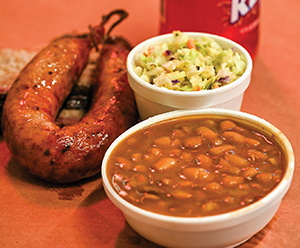
Barbecue businesses are often passed down through generations, with side-dish recipes plucked off the family tree. Adrene Bracewell, owner Bryan Bracewell’s grandmother, started using recipes passed down from her German-Texan family to make batches of pinto beans and mayonnaise-based potato salad — simple, budget-friendly options for families.
Coleslaw was added to Southside’s menu around 2000, and it was another decade or so before macaroni and cheese, garden salads and baked potatoes were added to the menu.
It also took decades before side dishes made their way to the Kreuz Market menu in Lockhart. The restaurant at the old Commerce Street location changed hands in 1948 when the Kreuz family sold it to longtime employee and butcher Edgar ‘‘Smitty’’ Schmidt.
Fifty-one years later, in 1999, the restaurant was renamed Smitty’s Market by Schmidt’s daughter, Nina Sells.
The first side dishes made it to Smitty’s menu in 2001: potato salad and pinto beans, according to owner Sells. The beans, made from a Schmidt family recipe, take four hours to cook. Schmidt’s grandson, John Fullilove, brought a simple approach to the beans — only chili pods, bacon and salt are added for flavor.
Today, Smitty’s also offers coleslaw, green beans, creamed corn and macaroni and cheese, their most popular side dish.
Another Schmidt sibling, Edgar Schmidt’s son, Rick, retained the Kreuz Market name for his barbecue restaurant that opened in 1999 at 619 N. Colorado St. in Lockhart. Sides were introduced there in 2001.
‘‘We started with beans and German potato salad, and it has evolved from there,’’ said Rick Schmidt’s son, Keith Schmidt, the current Kreuz Market owner. Today, those two sides and coleslaw are staples. The pinto beans are anything but a tray filler, thanks to big chunks of jalapeno, a spice blend and a not-so-secret ingredient from the pit: well-cooked chopped brisket.
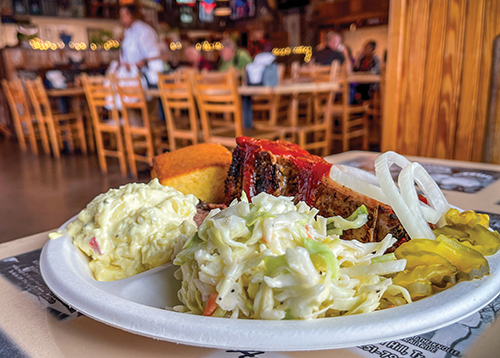
Macaroni and cheese is the most popular side at Kreuz’s. Another side, sauerkraut, harks back to Kreuz’s German roots, with caraway seeds adding a traditional flavor to the fermented cabbage. Homemade banana pudding is a closing complement to the smoky, salty meats.
At Black’s, the first side dish was introduced in 1937 — pinto beans crafted by second generation co-owner Norma Black. The beans served there today still follow her recipe. Other sides followed in the 1970s, all made from family recipes. ‘‘It was a practical decision. My mother was a great cook. More and more people were eating out, and they wanted sides,’’ said Kent Black, third-generation pitmaster at the restaurant.
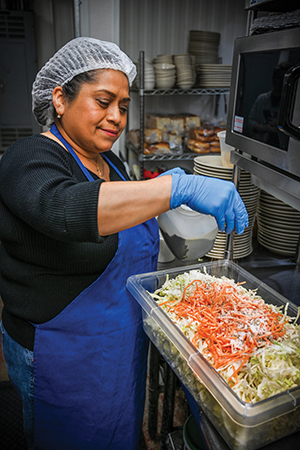
In Brenham, Nathan’s BBQ has been located at 1307 Prairie Lea St. for almost 15 years. Manager Cyndi Murski said their sides are prepared from recipes that originated with founder Nathan Winkelmann’s grandmother. The recipes evolved over time. Traditional potato salad joins coleslaw and baked beans on the menu, and Nathan’s creamy macaroni and cheese is its most popular side.
About 13 miles east of Nathan’s is Chappell Hill Sausage Company, 4255 Sausage Lane. Frank and Clara Cone bought the business in 1968 and for decades produced sausage in bulk for regional stores. In the 1990s, the Cones and their children added a retail store, and in the early 2000s, they opened a restaurant on site. The business still sells sausage in bulk.
Tricia Cone said Chappell Hill Sausage Company’s vinegar-based coleslaw and mayonnaise-based potato salad are made using family recipes her parents made at home. She and her siblings make the same dishes in their own homes today.
If you grew up in Texas, both taste like good memories.
THINKING OUTSIDE THE PIT
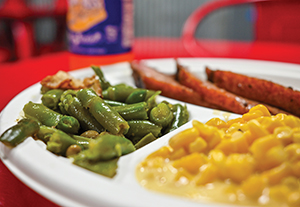
Some barbecue spots across the region stick with only the classic sides while others, like Outlaws BBQ at 1380 N. Main St. in Giddings, offer both traditional and unique side dishes.
Outlaws is a popular spot for locals and travelers. They sell coleslaw, potato salad, macaroni and cheese, green beans and pinto beans along with fan-favorite “Outlaw corn” on Fridays and Saturdays only.
Co-owner Shane Hoffman is primarily the pitmaster. Jason Heuerman is “the side guy” who adds Velveeta, cream of mushroom soup, cream cheese and jalapenos to the corn for a unique twist, Hoffman said.

Luling’s City Market offers its own take on the traditional side duo of beans and potato salad. Its beans are made fresh daily with bacon and salt, and pair well with potato salad and smoked meats, said Joe Capello, City Market’s pitmaster and manager.
Another Luling barbecue joint, Luling Bar-B-Q at 709 E. Davis St., was founded in 1986. Co-owner Ken Blevins strives for crowd-pleasing tastes for the restaurant’s typical mix of lunching locals and urbanites driving in for a day. The pinto beans are seasoned with cumin for a Southwestern twist. The potato salad packs a lot of flavor and texture into one bite. Two of the restaurant’s most popular sides are broccoli salad and au gratin potatoes.
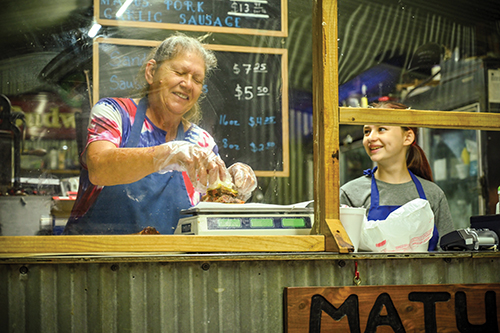
In Burleson County, Matus Bar-B-Q keeps things simple but soulful. This family-run spot at 304 W. Buck St. in Caldwell has been a local favorite since 1995. Robin Matus and her daughter Renee Matus co-own the business and open the doors on Saturday and Sunday only from 6 a.m. to 2 p.m. Regulars know to get there ahead of the crowd because the restaurant often sells out of barbecue by 10 a.m. “We call it barbecue for breakfast,” Renee said.
The sides are a modest but meaningful trio: pinto beans, green beans and potato salad. Both beans are made fresh in-house each day and cooked with bacon, because “bacon just makes everything better,” Renee said. What they lack in frills, they make up for in heart — and food that keeps customers coming back.
Renee’s daughters Ember, 11, and Kennedy, 10, also work each weekend. Ember sells homemade bread that’s become a staple of the Matus experience. Renee’s son, Marshall, 16, cuts wood for the barbecue pit and takes care of the landscaping.
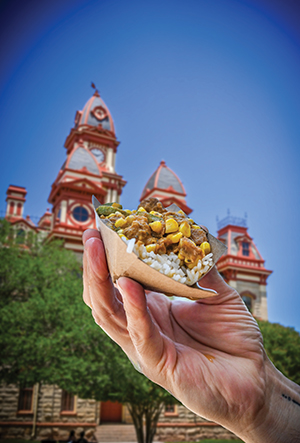
New generations bring new flavors to tradition. Barbs B Q, a women-owned barbecue restaurant founded by Alexis Tovías Morales, Haley Conlin and Chuck Charnichart, is one of the newest names on the Central Texas barbecue scene and it is a bona fide phenomenon. The barbecue joint at 102 E. Market St. in Lockhart has made several best-of lists since opening in 2023. In November, the restaurant earned a prestigious Bib Gourmand from the inaugural Michelin Guide Texas, an award given to exceptional restaurants that offer good value.
The sides at Barbs B Q are part of the reason for the acclaim. The restaurant serves boats full of black beans instead of pinto, and each bite is a flavor bomb. Sometimes you get a smoky slice of sausage, a salty crumble of queso fresco or a fresh note of cilantro.
Stew might seem like an unlikely addition to the regional sides lineup, but Barbs B Q ladles a golden mixture of corn, squash and pork over a bed of white rice.
The “green spaghett” is another side that has become a trademark: Creamy poblano sauce clings to slurpable noodles, with a flavor as vibrant as the color and a bit of spice in each bite.
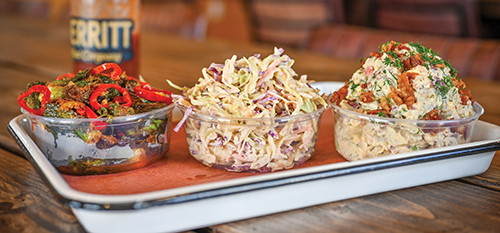
Merritt Meat Company in Fayette County also has adventurous tastes. Just steps away from Royers Pie Haven and nestled among vintage boutiques at 197 Henkel Circle in Round Top, Merritt makes yet another case for Bluebonnet-area barbecue.
Merritt Meat Company was originally the Round Top Smokehouse and was renamed in honor of the late Lee Ellis, the former owner whose middle name was Merritt. The new owners, Abbie Byrom-Botello and Leonard Botello IV — who also own Truth BBQ locations in Houston and Brenham — wanted to build on Ellis’ legacy, including his menu, which featured some Asian-inspired dishes.
Vegetables get their share of the sides spotlight at Merritt. Oaxacan-style Brussels sprouts are crisp on the outside and tender on the inside, drizzled in tangy, spicy sauce and tossed with a few kicky peppers. The traditional, crisp Texas-style coleslaw is light, with mustard seed-dotted strands of cabbage cutting the heaviness of the rest of the tray — we’re looking at you, pulled pork.
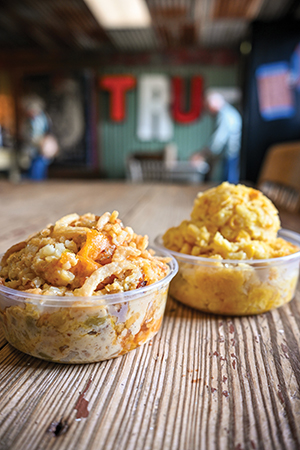
Slow down in Washington County, or you might miss the corrugated metal structure that houses Truth BBQ at 2990 U.S. 290 in Brenham. It’s worth a U-turn for adventurous eaters. Truth’s corn pudding blends fresh, slightly decadent flavors for a comfort food that is soft and gooey, with a few caramelized pieces of gold studded throughout. It’s like eating kernels fresh off the cob and a homey Thanksgiving stuffing at the same time.
Truth BBQ’s cooks know their way around cheese. The curly noodles of the restaurant’s hearty macaroni and cheese have a pleasantly chewy bite and cling to a zingy sauce. Breadcrumbs and cheese on top add texture and a layer of toasty flavor. Then there’s the tater tot casserole, tasting like a salty bag of potato chips smothered in a blend of cheese and cream.
Top it all off with Truth’s seasonal cake flavors, available now through the fall: triple chocolate, strawberry, coconut, banana and caramel.
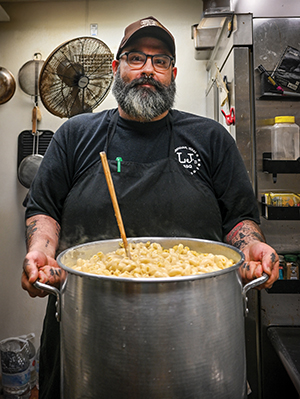
Just down the road in Brenham, Matt Cummins, one of the lead cooks at LJ’s BBQ at 1407 W. Main St., has been handling the sides for a couple of years. There’s a practical purpose to traditional sides, he said. Simplicity in cooking means you pay attention to every single thing.
Take, for example, the macaroni and cheese, LJ’s most popular side. Developed by pitmaster Corey Cook, it takes four to five hours to cook, Cummins said. They start the macaroni at 5:30 a.m., a low-and-slow process requiring constant stirring.
Street corn salad, a more recent addition to LJ’s menu, is one of Cummins’ favorites. Smoky corn, charred poblano peppers, mayonnaise, sour cream, cotija cheese, Tajin seasoning and cilantro go into this side.
All these creative twists on traditional sides at barbecue spots across the Bluebonnet region beckon old-timers and newcomers alike. Still some folks prefer to stick with tastes that have withstood the test of time.
Adrene Bracewell is 94 now, so she doesn’t come into Southside in Elgin much. The family brings the restaurant’s food to her.
“She never tells me the recipes aren’t right, but I know I need to check on things if she asks me, ‘So who made the potato salad today?’ or ‘Who made the beans today?’ ” Bracewell said. “She’s too nice to just say it’s not right.”
He pays attention to her gentle hints. Who wouldn’t want to keep their grandmother happy? n
— Sara Abrego and Kirsten Tyler contributed to this story
What’s your sides story?
Barbecue in Texas is a must-have, but the plate isn’t complete without the side dishes. We want to hear your sides stories! Do you have a favorite barbecue joint side dish or a fond memory associated with one?
Leave a comment in the barbecue story post on Bluebonnet's Facebook or Instagram for a chance to win a $50 gift card to your favorite Bluebonnet-area barbecue spot! The deadline is July 20, 2025. The winner will be contacted the following day.
Check out this story as it appeared in the July 2025 issue of Texas Co-op Magazine
Bluebonnet and LCRA representatives present a $13,219 grant to the Carmine Volunteer Fire Department for a new generator. The grant is part of LCRA’s Community Grants program. Pictured, from left, are Kate Ramzinski, LCRA regional affairs representative; Sherry Murphy, Bluebonnet’s Giddings-area community representative; Byron Balke, Bluebonnet Board Assistant Secretary/Treasurer; Cooper Meaders, VFD secretary; Margaret D. “Meg” Voelter, LCRA board member; Ryan Smith, VFD captain; Carol Freeman, LCRA board member; Chris Carmean, VFD fire chief; Dennis Gerland, VFD president; Daryl Ray, VFD vice president; and Kyle Merten, Bluebonnet’s Brenham-area community representative.
The Carmine Volunteer Fire Department will soon replace its inoperable generator with a new upgraded model to help the fire station remain operational even during power outages, thanks to a $13,219 grant from Bluebonnet Electric Cooperative and the Lower Colorado River Authority.
The community grant, along with $3,514 in matching funds from the VFD, will fund the purchase and installation of a new generator to help ensure firefighters can continue 24/7 operations during power outages, including receiving calls for help, refilling air packs, charging devices and maintaining critical communications.
“During hurricanes, wildfires and extreme cold weather events, the station’s new generator will allow our department to provide continued service to our area of responsibility,” said Cooper Meaders, secretary of the Carmine VFD. “We also provide mutual aid to our neighboring departments, so this will benefit the larger community.”
The addition of a functional generator also will enable the department to provide a cool or warm working environment for first responders during power outages.
The Carmine Volunteer Fire Department serves Carmine and surrounding areas in northern Fayette County and by responding to fires, vehicle accidents and medical emergencies. The all-volunteer department plays a vital role in protecting rural communities where backup support can be miles away.
“CVFD’s commitment to provide our local community with 24/7 fire protection and first responder services is our No. 1 priority and this grant helps us achieve our mission,” Meaders said.
This is one of five grants recently awarded by Bluebonnet and LCRA through LCRA’s Community Grants program, which helps volunteer fire departments, local governments, emergency responders and nonprofit organizations fund eligible capital improvement projects in LCRA’s wholesale electric, water and transmission service areas. Bluebonnet is one of LCRA’s wholesale electric customers and is a partner in the grant program.
Applications for the next round of grants will be accepted in January. More information is available at lcra.org/grants


