


Spring break is hiding in plain sight




Recent news
What’s the right way to load a dishwasher? When is the thermostat set too high? Household appliances make life easier — and spark plenty of debate. Here’s what experts say about some of the most common appliance disagreements
THE THERMOSTAT BATTLE
“It’s too hot. I’m burning up!” “It’s freezing in here. I can’t stand it!”
Expert opinions: Someone isn’t going to like these answers — at least at first.
The U.S. Department of Energy recommends setting your thermostat to 78 degrees when you’re home and it’s hot outside. A common compromise is 75 to 77 degrees, especially in newer, energy-efficient homes.
Find the warmest setting everyone can tolerate by gradually raising the temperature over several days. Even a one- or two-degree increase can add up to meaningful savings over a summer.
Cooler at night? Experts suggest lowering the thermostat just 2 or 3 degrees. Bigger drops can cause your HVAC to run constantly.
Use the Auto fan setting. Running the fan continuously during hot weather can add $10 to $25 a month to your electric bill, according to Central Texas utility guides.
Most important: Use a smart thermostat — and stick to a schedule. Frequent manual changes can cause short cycling and wasted energy. Used properly, a smart thermostat can cut HVAC energy use by 10% or more in hot weather.
Ways to stay cooler:
- Ceiling fans can make a room feel about 4 degrees cooler.
- Use breathable bedding made of cotton, linen or bamboo.
- Take a cool shower before bed.
- Drink cold water or apply a cool, damp cloth to your neck or wrists.
- Close blinds during the hottest part of the day; blackout blinds work best.
- If it’s cooler outside at night, open windows on opposite sides of the house. Use box fans to pull cool air in and push warm air out, then close windows and switch back to HVAC once indoors cools.
During cold snaps:
- Set the thermostat to 68 degrees or lower to save energy.
- Let sunlight warm rooms during the day.
- Seal leaks with weatherstripping or caulk.
- Layer clothing and blankets.
- Heated blankets use less electricity than HVAC; follow safety instructions.
- Flip ceiling fans to spin clockwise to push warm air down.
- Space heaters are fine briefly, but never unattended or while sleeping.
HOW TO LOAD THE DISHWASHER
“You’re cramming everything in wrong!” “It’s fine — the water will reach it.”
Experts say: Crowding blocks water and spray arms. Leave space for circulation. Face dishes toward the center and angle them downward. Put oversized items on the sides and back of the lower rack. Very dirty items go face down on the bottom.
Skip pre-rinsing. Scrape off large food scraps, but let detergent enzymes do their job. Newer machines use sensors to choose the best cycle.
Load forks and spoons handle-down; knives blade-down. Cups, glasses, small bowls and dishwasher-safe plastics go on the top rack. Avoid washing nonstick pans (unless labeled dishwasher-safe), brass, bronze, wood or delicate items.
And yes — your dishwasher has a filter. Clean it regularly.
HAND-WASHING VS. DISHWASHER
“Handwashing saves water.” “No, the dishwasher does.”
Expert opinions: Modern energy-efficient dishwashers use as little as 4 gallons per load. Handwashing under running water often uses far more and can keep electric water heaters running longer. Newer dishwashers use less than half the electricity of older models and can save more than 8,000 gallons of water per year. Use air-dry instead of heat to save even more energy.
TOP-LOAD VS. FRONT-LOAD WASHERS
“Top-loaders are easier.” “Front-loaders clean better.”
Expert opinions: It depends.
Top-load washers cost less, handle larger loads and wash faster with less maintenance. They use more water, are tougher on clothes and don’t spin out as much water, which can lengthen dryer time.
Front-loaders use less water and energy, clean more thoroughly and extract more water during spins. They cost more, take longer per cycle and require more cleaning to prevent odors and mildew.
One more thing: Most people use too much detergent. According to Consumer Reports, many use twice what’s needed.
Check labels and use the correct type and amount.
DRYER DOS AND DON'TS
“Don’t overload it!” “We’re wasting energy if it’s not full!”
Expert opinions: Full loads are efficient, but overloading restricts airflow and increases drying time and wear.
Medium heat works for most fabrics. Save high heat for towels and bedding. Use moisture sensors if available and separate loads by fabric weight.
Clean the lint screen after every load and regularly inspect vents and ducts.
When possible, line-dry or use indoor drying racks — especially during hot, sunny weather.
PLUG OR UNPLUG?
“Unplug everything not being used!” “That’s outdated advice.”
Expert opinions: Most modern chargers and electronics draw minimal power when off. Instead, focus on high-draw or rarely used devices like space heaters. Smart plugs or power strips make it easy to cut power when needed.
During thunderstorms, unplug sensitive electronics such as TVs and computers. Lightning strikes can send surges through power or internet lines. Whole-home surge protectors and device-specific protectors add extra protection, and some experts recommend electronics insurance.
FRIDGE FUSSES
“Turn it colder!” “You’ll freeze the lettuce!” “Close the door!”
Expert opinions: Leaving the refrigerator open for more than a minute wastes energy and strains the compressor. If you can’t find what you need quickly, reorganize.
The refrigerator should be set to 40 degrees and the freezer to 0 degrees, according to federal food safety guidelines.
Some experts recommend 37 to 38 degrees as a compromise. Use a fridge thermometer to check accuracy.
Don’t jam-pack shelves — air needs to circulate — but don’t leave it empty, either. Aim for about two-thirds full and keep vents clear.
The door is the warmest spot; the back and bottom shelves are coldest. Store ready-to-eat foods on top, dairy and leftovers in the middle, and raw or moisture-prone items on lower shelves or in bins. Heavy items belong on the bottom shelf.
Sources: U.S. Department of Energy; Energy Star; Bluebonnet Electric Cooperative; U.S. Energy Information Administration; American Council for an Energy-Efficient Economy; Consumer Reports; Wirecutter; National Fire Protection Association; HowStuffWorks; Good Housekeeping; U.S. Food and Drug Administration; U.S. Department of Agriculture
Program prepares apprentice lineworkers to keep 13,000 miles of line and 144,000 meters safe and reliable
By Connie Juarez
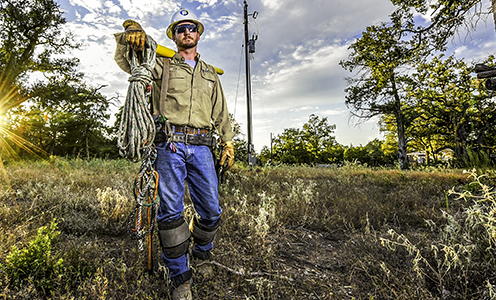
During the last several years, Gunnar Schwartz learned that a lineworker’s job involves more than putting up poles and stringing wire.
“You learn how the control center and substations operate, which helps you see the bigger picture of how everything connects,” Schwartz said. He and 11 other Bluebonnet apprentices learned how to build overhead and underground lines, troubleshoot and restore power during outages, maintain electrical equipment and install and repair meters.
Beyond the technical skills, the program emphasizes the importance of working with a team and building on others’ experience and strengths.
Schwartz, who is based in Giddings, is proud to have finished the program, but he is also aware of the expectations that come with the job.
“Now you’re the one people look to for answers,” the 30-year-old graduate said. “It’s a good feeling, but it comes with more responsibility.”
Schwartz and the other 11 apprentice lineworkers at Bluebonnet Electric Cooperative completed their training in 2025 and joined the co-op’s experienced team of journeyman lineworkers. They work to ensure members have safe, reliable power across the cooperative’s 3,800-square-mile service area.
Completing Bluebonnet’s lineworker apprentice program requires 8,000 hours of on-the-job training and 672 hours of technical instruction, typically requiring four years. Graduates earn certification from the U.S. Department of Labor and are prepared to handle a wide range of fieldwork.
Joining Schwartz in earning journeyman certification were Huston Burgess, Colton Harris, Cooper Lucherk, Thomas Medrano, Tanner Meuth, Darrin Ott, Ryan Smith, Terry Swonke, Brett Wellmann, Brent Westbrook and Trevor Williams. Lucherk, Swonke, Wellmann and Williams began their careers as lineworker interns in 2021, completing a six-month training program before beginning the apprentice training.
Harris, who is based in Bastrop, said the apprentice program showed him the value of building on a team’s strengths.
“There are things I’m not as good at as others, and things I’m better at,” he said. “It’s all about working with people and understanding there are many ways to do things.”
Working to restore power during ice storms gave Harris his most meaningful experiences on the job. “Seeing people’s relief when the lights came back on — that’s what makes it all worth it,” he said.
Reaching journeyman status was important to Harris. “In my family, there’s a long tradition of line work,” he said. “It’s exciting to reach this point, but the journey is just beginning. There is so much more to learn and accomplish.”
Including the 2025 graduating class, 165 apprentices have completed Bluebonnet’s lineworker program since it began in 2004.
Chad Weiss, operations superintendent in Brenham, said the apprentice program provides a solid career path that is close to home.
“The majority of the candidates who take part in our program are from Bluebonnet’s service area,” Weiss said. “The program produces skilled, safety-driven, dependable lineworkers who take pride in their work. It’s great to see them building a future in the same communities they’re helping every day.”
The Bluebonnet intern program, which started in 2018, provides six months of technical instruction in line work. To advance into the apprentice program, participants must also obtain power-pole climbing certification and a commercial driver’s license.
To learn more about Bluebonnet’s lineworker internship and apprenticeship programs, visit bluebonnet.coop/careers.


