



Spring break is hiding in plain sight





Recent news
Story by Clayton Stromberger
Photos by Sarah Beal
Along a quiet stretch of roadside on the eastern edge of Bastrop, a man and a dog move side by side in knee-high brush, slowly zigzagging along a fence line.
“Charlie, search!” says the man, gently but firmly. “Find it. Let’s go.”
The black Lab-shepherd mix with intent amber eyes is wearing a blue harness vest hooked to a long plastic leash held loosely by his handler, Clifton Smith. That gives Charlie room to maneuver through the underbrush.
Charlie leads with his nose, swooping in low for extra sniffs, then swivels in a new direction and circles back, like a kid on a scavenger hunt. On a nearby front porch, a man in a weathered gimme cap pauses and squints quizzically at the scene.
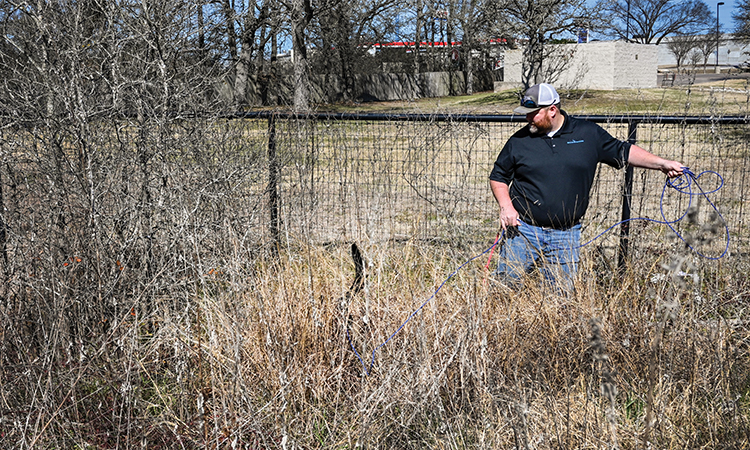
It's a typical workday, and Charlie is up to his tail in tall grass, left, as he sniffs for water leaks along Union Chapel Road in Cedar Creek with his handler, Clifton Smith. The pair work for Aqua Water Supply Corp., which serves residents and businesses in a 1,065-square-mile area in six Texas counties, including most of Bastrop County and parts of Travis, Lee, Caldwell, Fayette and Williamson counties.
“Show me,” Smith says to Charlie. “Show me. Where? Search. Find it. Find it. Where’s it at?”
Suddenly Charlie, his tail pointed upward, zeros in on a spot and plants his paws in a quick bow. His eyes flash toward his co-worker. Here! The dog’s subtle “alert” means that somewhere beneath that patch of roadside grass, water is slowly seeping from an Aqua Water Supply Corp. pipe.
“Good boy, good boy!” Smith responds, and from his pocket he produces a slingshot-style ball toy. “Here, go!” and Smith sends the ball whirling across a patch of grass. He drops the leash and Charlie bolts in happy pursuit. While Charlie is playing, Smith marks the spot with a small blue flag.
It’s another successful moment in the field for the Aqua Water’s most unusual full time employee. Charlie, a 2½-year-old rescue dog, is the first working water-leak detection dog in Texas, and one of only four known to be working full-time in the U.S.
Charlie and Smith started working together in May 2021. Their partnership is an innovative new leak-detection approach for the Central Texas water company, which supplies drinking water to rural residents and businesses in a 1,065-square-mile area that includes most of Bastrop County and parts of Travis, Lee, Caldwell, Fayette and Williamson counties.
After one more ball toss and fetch, Charlie and Smith hop back into their Aqua Water Supply vehicle – a silver Tahoe with caution lights on the top and “Aqua K-9” emblazoned on the side – and head down the road for the next service call. The rest of the day’s schedule: Work hard, play hard, rest a bit and repeat, in endless variations.
Later, Aqua Water will send a crew to dig where Charlie hit the spot and repair a leak that could have gone undetected for months.
Leaks are a very common problem in the water delivery industry. “Like every other water utility, we have a large unknown water loss,” says Dave McMurry, Aqua Water’s general manager. “The average across the country is 10 percent to 30 percent annually. That’s a lot of money, so you can justify some expense looking for it.”
Aqua has about 1,900 miles of water line, much of it a foot and a half underground. Leaks can be caused by problems as diverse as aging metal pipes or shifting rocks that grind into newer PVC pipe. Traditional approaches to detecting leaks – acoustic equipment to listen for the hiss of escaping water or infrared cameras – can be hit or miss, and satellite scans seeking water line anomalies are often prohibitively expensive for most regional water companies.
Charlie’s payday comes hourly in the form of his favorite thing: playtime. He has proved to be a good return on Aqua Water’s total investment in him, an estimated $20,000. Since he started working less than a year ago, he and Clifton Smith have located about 150 leaks together.
How does Charlie “smell” water? He doesn’t: He sniffs for chlorine. The federal Environmental Protection Agency requires all public water systems in the U.S. to add a small amount of chlorine (or a chlorine-based disinfectant) to its water. That amount has been deemed safe for water use or consumption. The chlorine kills disease-causing bacteria, viruses and other microorganisms.
As leaking water sinks into the soil, the added chlorine becomes a gas that slowly rises through small air pockets toward the surface. That is what the remarkable scent-analyzing instrument known as Charlie’s nose has been trained to seek and identify.
Across the centuries, humans have trained dogs to do everything from aid in the hunt to herd farm animals to support people with impaired vision or assist police and military. In recent years, dog training has become more targeted toward skills using their stunningly keen sense of smell.
A dog’s nose can be 10,000 to 100,000 times as sensitive as a human’s. They have up to 300 million olfactory receptors in their noses compared with our 5 million to 6 million, according to research reports. In recent years, service dogs have been trained to sniff out unhealthy blood glucose levels in people with diabetes, cancer from a patient’s breath or, for those with epilepsy, indications of an upcoming seizure before it happens.
Reports of a successfully trained water leak-detecting dog first surfaced in Australia in 2018. Then a second trainee, a cocker spaniel named Snipe, started sniffing out leaks in the United Kingdom.
America’s first leak-detection dog is Vessel, who started working for Central Arkansas Water in 2019. Vessel, also a Lab-shepherd mix, learned his craft from respected Arkansas dog trainers Carrie Kessler and Tracy Owen at the request of the CEO of Central Arkansas Water, who wanted to give this new approach a try.
Heather Tucker, Aqua Water’s conservation manager, read about Vessel and General Manager McMurry asked her to research what it would take to get a leak-detection dog for Aqua. She contacted Kessler and Owen, who already had a perfect candidate: Charlie.
The bouncy 1-year-old rescue pup had been adopted by a family with four children. They loved Charlie, but the family could not keep up with his incessant fixation on playing fetch. He would play for hours without tiring. Trainers call this trait “ball drive” and it is key to Charlie’s specialized training.
Charlie’s owner had heard about trainers Kessler and Owen and their involvement in Arkansas Paws in Prison, which teaches inmates at seven Arkansas prisons how to give basic obedience training to rescue dogs. The family hated saying goodbye to Charlie, but hoped the program would give him a meaningful outlet for his energy.
It worked: Charlie’s fetch fixation and intelligence made him a great candidate for scent training.
Since finding the smell of chlorine was the goal, trainers Kessler and Owen used chlorine in the same way they did with other scent-based training. They slowly guided Charlie toward a Q-tip moistened with city water. When he found that chlorine scent, he got his treasured reward – playing ball. This “imprinting” training gradually moved through stages, with the chlorine becoming harder and harder to sniff out.
The next step was to find the right partner for Charlie, since scent-detection dogs work closely with their handler. “We had hopes for the dog,” Aqua Water’s McMurry recalls, “and I knew that whoever apply we put as the handler had to be very dedicated. Both of them as a team were going to have to prove this concept. I was kind of concerned because I stuck my neck out a little bit.”
Clifton Smith, an 18-year veteran of the company, grew up in the Bastrop area and began working at Aqua right out of high school. He started out running a weed-eater around the smiley-faced water towers and worked his way up to a zone operator and backhoe driver. When Smith heard about the new position, he decided to apply to become Aqua’s first K-9 leak detection specialist.
“Clifton’s very driven too,” says his wife, Erin Smith. “He was excited to have a new challenge. It had never been done before in Texas, and he was excited to be a part of that.” Smith traveled to Arkansas for a week of training. He and Charlie bonded right away.
Charlie’s leak alerts can be subtle. Smith had never trained a dog, and he and Charlie had to form a close working relationship – one that’s still evolving. Smith has regular trouble-shooting conversations with Kessler, Owen and Vessel’s handler Tim Preator in Arkansas.
Charlie lives with Smith, his wife and their three children (and three other pet dogs) at their home near Paige. The Smiths make sure to give Charlie only distilled water in his bowl, as they do with all the other pets, just so he’s not over-exposed to the chlorine smell on his off hours.
Each weekday morning Smith and Charlie hop in the Tahoe, drop the Smith children off at school and begin their workday. Sometimes they respond to a call from a customer who suspects a leak, or they follow up Smith’s hunch about a problem area where a line is known to have issues. Other times Smith cruises along certain stretches of the service area, looking for a tell-tale patch of green amid brown grass.
Charlie’s reputation is growing within the Aqua ranks, McMurry says, as the dog continues to alert in spots where no one suspected a leak. Aqua Water says Charlie is accurate most of the time, and is much more accurate than other leak detection devices.
“The manager of our distribution system at first said, ‘I'll believe it when I see it,’ ” McMurry says. “Charlie's convinced them all. One of them said to me recently, ‘When Charlie says there’s a leak, I dig.’ ”
Charlie has become something of a celebrity around the Aqua service area, with his special brown “working dog” vest. You might see him and Smith at Petco on a pit stop some weekday. He wears the blue leak-detection vest only when he is working. “He knows, once I get that vest out, it’s time for business,” Smith says.
When he isn’t working, Charlie is lovable and gregarious. “He never meets anyone who isn’t a friend,” Smith says of his partner. Once, Smith recalls, Charlie even charmed two Bastrop County Sheriff’s Department officers. They had pulled Smith over, suspicious that he was gallivanting around in a fake K-9 police car.
“I told them about Charlie and what he does, and at first they were like, ‘You gotta be kidding me,’ ” Smith recalls. “They ended up taking a lot of photos with him.”
Kessler and Owen in Arkansas now each have their own dog training business, and there are more leak-sniffing dogs under their tutelage. For now, Charlie remains one of a small and select group of dogs doing this work.
No one knows how long Charlie’s career will last. His retirement date is “whenever he decides he doesn’t want to work anymore,” Smith says. Then Charlie would transition to the laid-back lifestyle of a regular pet at the Smiths’ home.
In the meantime, Charlie and Smith continue to develop their unique partnership. Smith works to keep things fun and interesting for Charlie, mixing up which balls he uses each day and working in some treats and tug-toy action. Charlie’s desire to chase a ball hasn’t dimmed. “He’ll play ball until your arm won’t work anymore,” Smith says.
“We talk about the ‘ball drive’ and the ‘food drive’ with these dogs,” he says, “but I think at the core of all of it is that they are really wanting to be pleasers and work for you to make you happy – and when that happens, they get to play.”
THE NOSE KNOWS

Just how good is the sense of smell in a dog like Charlie? Probably much better than you realized:
- He may have a sense of smell up to 100,000 times more acute than a human’s.
- An analogy: If a scent was sugar, a human may notice a cup of coffee has a teaspoon of sugar in it; a scent dog can detect that same teaspoon of sugar in 1 million gallons of water.
- Humans have up to 6 million “olfactory receptors” in our noses. A Lab mix such as Charlie could have 220 million or more receptors.
- The part of a dog’s brain that analyzes smells is 40 times as great (proportionately) as that part in the human brain.
- When a dog inhales, a fold of tissue separates oxygen into two air flows: one for breathing, the other for smelling.
- Dogs can wiggle both nostrils in different ways, and they can determine which nostril a scent came through.
- Dogs have now been trained to successfully smell the COVID-19 virus from a person’s breath or urine. In one study, dogs were 97.5% accurate.
- Scent dogs have been trained not just to sniff out people, cadavers, explosives and drugs, but also diseases (including cancer) and oncoming epileptic seizures, money, invasive plant and animal species, fungi and more.
Sources: NOVA/pbs.org; University of Oslo, Norway; Pennsylvania State University; University of Pennsylvania School of Veterinary Medicine, National Center for Biotechnology Information, PLOS ONE journal; Global Forensic and Justice Center at Florida International University; dog-cognition researcher Alexandra Horowitz, author of “Inside of a Dog”
BEST BREEDS FOR SCENT SKILLS
Not all dogs are created equal. These are the breeds with the best senses of smell.
Bloodhound
At the top of most lists, this breed is sometimes called “a nose with a dog attached.’’ The bloodhound has the largest olfactory cortex (40 times as large as a human’s) and 300 million scent receptors (more than any other scent dog). It can follow a scent for days and the loose skin around its face and long drooping ears trap scent particles. It is the first animal whose evidence is admissible in some U.S. courts.
Basset hound
A low-slung stature keeps their wrinkled faces and long ears close to the ground to enhance ability to follow a scent. Originally bred by French monks during the Middle Ages to hunt hares, basset hounds underwent more breeding in Great Britain in the 1800s. A close second to the bloodhound in scent-trailing ability.
Beagle
A lot of energy in a small package, the beagle was bred for hunting prey through forests. It has 225 million scent receptors in the nose, equal to the much larger German shepherd. In contrast, a dachshund has 125 million scent receptors, and humans have a mere 5 million to 6 million. Beagles are used by law enforcement and to sniff out drugs, bombs and illegal food imports.
German shepherd
Bred to be a herding dog but better as a scent detector, the German shepherd tracks scents in the air as well as near the ground. It’s particularly good at tracking human scents. A longtime favorite of police, military and others for bomb detection and search-and-rescue skills, it can also be an excellent service dog and excel in obedience trials. The German shepherd is the second most popular breed in the U.S. after Labrador retrievers.
Labrador retriever
Originally bred to help fish catchers in Newfoundland pull nets and retrieve fish, Labs are also America’s favorite dog. They are used for all manner of scent tasks, including search and rescue, explosive detection, and, more recently, to sniff out cancer and other diseases by smelling breath or urine. Labs are intelligent and typically easily trained.
Belgian Malinois
Agile and weighing less than a German shepherd, the Malinois was originally bred to herd. It can track people or substances, leap, pull sleds and excel in agility courses. For more than 100 years, it has been used by police and military for sniffing out contraband and other tasks. It is favored by Navy SEALS as trained parachutists and repelling attacks, and several Malinois protect the grounds of the White House.
Sources: National Center for Biotechnology Information, Family Dog Project detection test report, American Kennel Club, biologydictionary.net
Download this story as it appeared in the Texas Co-op Power magazine
By Alyssa Dussetschleger
After last February’s record winter storm, Central Texas residents have rushed to buy back-up generators in case their electricity is out for a prolonged period. However, generators can be dangerous, particularly portable ones that typically run on gasoline. A larger, permanently mounted standby generator, installed by a licensed, qualified electrician, can be a safer option, but they are backlogged by months at retailers, are more expensive and also pose some hazards. Although the National Oceanic and Atmospheric Administration predicts a warmer Texas winter in 2022, the Farmers’ Almanac says January could bring subfreezing temperatures. Whatever the winter of 2022 has in store for Central Texas, consumer interest in standby generators is likely to continue well beyond the season.
About standby generators
Although less-expensive portable generators are readily available, more costly and larger standby generators are getting attention from many Central Texas residents because they produce more power and are safer than portables.
These larger home generators must be permanently mounted outdoors by licensed, qualified professionals. Because they are in high demand in Texas, there are lengthy waitlists to buy and install these generators.
Home Depot and Lowe’s offer standby generators for $2,500 to $6,500, based on size requirements. Consultation and installation costs range from $3,000 to $6,500.
Among the most popular manufacturers of standby generators are Generac, Champion, Briggs & Stratton and Honeywell. The most popular brand sold by Zaskoda Repair in the city of Caldwell is Generac’s Guardian 24,000-watt generator. “These are typical for 2,000- to 2,200-square-foot homes,” said Zaskoda Repair’s owner, Tim Zaskoda. At his store, a generator, materials and installation range from $12,000 to $14,000. You can get an assessment appointment within two weeks from Zaskoda, but demand has led to months-long delays of generator delivery and installation.
In the Brenham area of Washington County, Zenith Power Systems sells and installs generators, but they have a waitlist of about six months for generators to arrive and be installed. The waitlist is shorter (about three months) for the company to send a factory-trained technician to survey your property and help you select a generator.
When connecting a standby generator, a certified generator installer or licensed electrician must temporarily have Bluebonnet disconnect your electric power to safely connect the generator to a transfer switch and your meter.
Bluebonnet members can speak to a member service representative by calling 800-842-7708 from 8 a.m. to 5 p.m., Monday through Friday, to schedule a line worker to temporarily disconnect power to the members’ home or business while a generator is installed and reconnect power when the job is done. Line workers also inspect the connection from the generator to the meter to ensure it meets safety requirements.
Standby generators require annual maintenance, and many installers offer annual maintenance packages for a few hundred dollars.
Kenny Lehmann, a Bluebonnet maintenance specialist in Giddings, installed a standby generator at his home in October 2020. He tests it weekly, using an app on his smartphone to turn it on. The app lets him manually operate the generator, see when it is running and how much power it is supplying.
Standby generators can still be dangerous. Overloading the generator by using more power than the machine is rated for can damage it and anything connected to it. However, when properly installed and safety measures followed, standby generators are far less dangerous than their smaller, portable counterparts.
The ABCs of generators
There are three basic types of generators, which vary in size, price, power source and safety:
Standby
Standby (whole house) generators are the most powerful and safest for home use. They range in power from 5,000 to 50,000 watts, and can cost nearly $2,000 up to $20,000. They run on natural gas or liquid propane and must be installed by a licensed, qualified electrician. A typical home requires, at minimum, a 5,000-watt generator to power its electric essentials. Right now, large permanently pad-mounted standby generators are backlogged several months at major home improvement stores, and for as long as a year for some area retailers that sell the popular Generac brand.
Portable
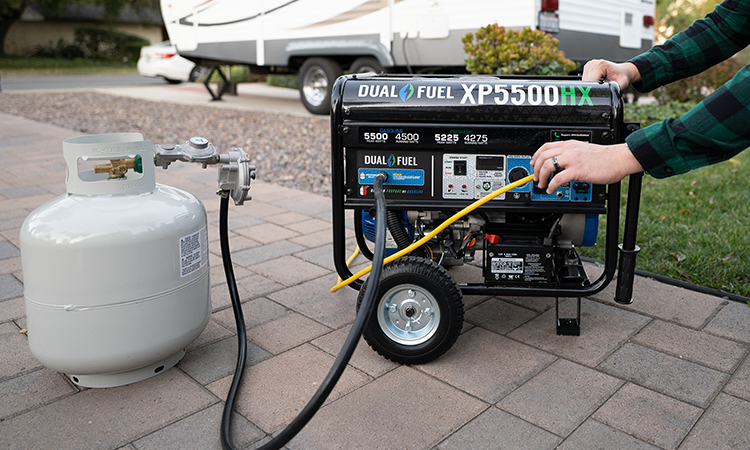
Portable generators typically run on gasoline, but some use diesel or propane. They can provide 3,000 to 8,500 watts of power and cost about $400 up to $2,500. In November 2021, many were available in large home improvement stores in the Bluebonnet region. Lower-cost, lower-power models provide just enough power for essential items, such as a refrigerator and to charge a few phones. Portable generators can produce harmful levels of carbon monoxide if operated in an enclosed area. At least 430 people die from carbon monoxide poisoning every year, according to the Centers for Disease Control and Prevention. This type of death is preventable if portable generators are operated outdoors and safety guidelines are followed.
Inverter
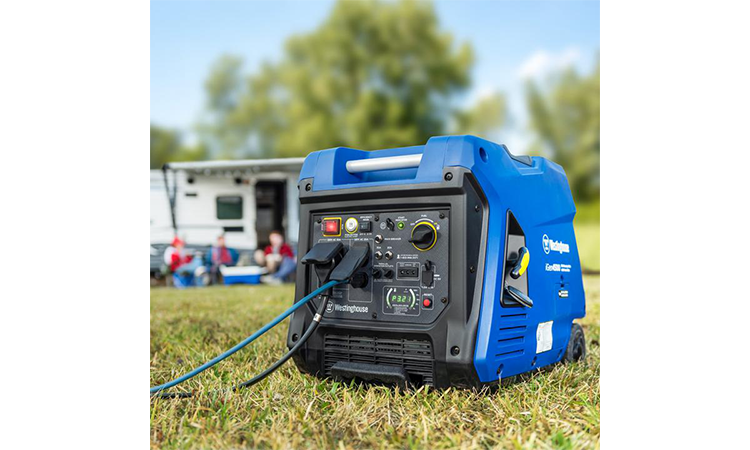
Inverter generators produce about the same amount of power as portable generators and also operate on gasoline. They cost from $300 to $4,000 and must be operated outdoors to prevent carbon monoxide poisoning. They are usually lighter and more quiet than portable generators because they automatically throttle down to provide only power when it is needed, according to Lowe’s home improvement store website. A 2,000-watt inverter generator can power a single household appliance.
Standby generator dos and don'ts
DO plan ahead for how much power you’ll need from the generator. It should produce more power than you think you’ll need in order to avoid an overload. Find a sizing calculator at generac.com.
DO keep your generator on a flat, stable surface, with its exhaust venting away from windows and doorways. This will prevent carbon monoxide poisoning. A generator cover can protect it from the elements.
DO use the proper type of extension cords that are in good condition. Using frayed or ungrounded cords could cause a fire or electric shock. Overloading a multi-plug extension cord can be dangerous.
DO use qualified, licensed electricians to install and maintain your generator, and follow all manufacturer directions and local regulations.
DO install battery-operated carbon monoxide alarms in your home.
DON’T overload a generator. Look at its power rating. Overloading can damage valuable appliances and electronics.
DON’T connect a generator to your home’s wiring without a professionally installed transfer switch. That switch prevents backfeeding (reversal) of electricity along power lines, which could pose safety risks to line workers restoring power during an outage.
DON’T use your generator if it is wet or in standing water, or if you are wet. That could result in safety hazards and damage to the generator. Try to keep the generator dry and covered.
Download this story as it appeared in the Texas Co-op Power magazine »
More than 30 Bluebonnet Electric Cooperative members in January reported recent attempted phone scams by people claiming to represent Bluebonnet. The fraudulent callers have told co-op members that their power will be disconnected unless they make a payment immediately over the phone.
“Attempted scams like this are definitely on the increase,” said Matt Bentke, Bluebonnet’s general manager. “The key to stopping them is to be aware of them and know your account status. Our members can access their account information by calling our member services number or through our website or mobile app.”
Bluebonnet makes at least two attempts to remind its members whose payments are late – once by mail and again by a courtesy phone call – within 10 days after the payment due date on the bill. The call comes from the cooperative’s automated phone system.
If you are a Bluebonnet member who has not received a reminder in the mail or a courtesy call about your account, and someone calls demanding an immediate payment, do not pay. Do not provide the caller with personal information, information about your Bluebonnet account, or any banking or credit card account information.
Bluebonnet members can check their account status 24 hours a day, every day, from their computer, smartphone or tablet through the co-op’s website, bluebonnet.coop, via the MyBluebonnet mobile app or by calling 800-842-7708.
Along with fraudulent bill pay calls, a neighboring utility has recently received a report of a home robbery by people claiming to represent that utility. Be aware of people who come to your home claiming to represent Bluebonnet, or any other service providers. Bluebonnet employees carry photo identification badges, travel in company vehicles and wear shirts with Bluebonnet’s logo. Bluebonnet’s contractors may contact members in person or by leaving a card at their door; automated calls will notify Bluebonnet members in advance. If the individual or organization seems suspicious, do not let them in your home. Ensure the request is legitimate by calling Bluebonnet at 800-842-7708.
Report any potential scam attempts to Bluebonnet and your local law enforcement agencies.


