




Mostly harmless and widely misunderstood, snakes quietly patrol the Bluebonnet region doing important work as both predator and prey. Here are seven species you’re most likely to encounter — and what to know about them.
By Andrew Logan
Last summer, Mike Beech, a Central Texas wildlife control specialist, was called to a home in Bastrop after a family spotted an unfamiliar serpent in their backyard. By the time he arrived, nerves were frayed and the family’s young children were waiting in the house.
Beech already had a good idea of what he’d find. The homeowners sent him a photo, so Beech believed the long, sleek snake was a coachwhip, a nonvenomous species harmless to people. As he poked through the backyard garden, the snake bolted over his boot and zipped between the homeowner’s legs. “He leaps about as high as the fence line,” Beech said. Beech dove forward, caught the coachwhip by the tail, and secured it barehanded. Crisis averted.
The children were released from the house, and Beech let them touch the snake. He explained that while healthy respect for these animals is important, the kids shouldn’t grow up fearing them. Beech relocated the coachwhip far from the yard, where it could continue its quiet rodenthunting life.
Snakes are stitched into the everyday fabric of the Bluebonnet Electric Cooperative service area — and the rest of Central Texas. They surface along barbed wire fences, tuck themselves beneath woodpiles and make the occasional appearance in manicured backyards. While some species pose a risk to pets and people, most are harmless, and all play an essential role in our local ecology.
Despite that, they are one of nature’s most unfairly maligned neighbors. Learning how these important creatures live and behave can ease unnecessary fear and help people coexist with them more wisely.
More than 80 snake species live in Texas, and as many as 40 of them call Central Texas home. “Texas blows everybody out of the water when it comes to snake diversity,” said Paul Crump, a herpetologist with the Texas Parks & Wildlife Department. The abundance comes from the state’s diverse terrain and unique climate.
Bluebonnet’s service area sits at an ecological crossroads, where the Edwards Plateau fades into the Blackland Prairie, and the East Texas woodlands meet the Post Oak Savannah, with drier country to the south. “That habitat diversity is what drives snake diversity,” Crump said. In addition, Central Texas’ mild winters and long warm seasons help: Snakes, being cold-blooded, aren’t forced to exist underground as long as in colder regions. That makes human-snake interactions more likely.
Snakes You’re Likely to See
The Bluebonnet Electric Cooperative service area is home to dozens of snake species. Here are some of the most common.
Illustrations by Joe Stafford
Western Ratsnake or Texas Ratsnake
(Pantherophis obsoletus)
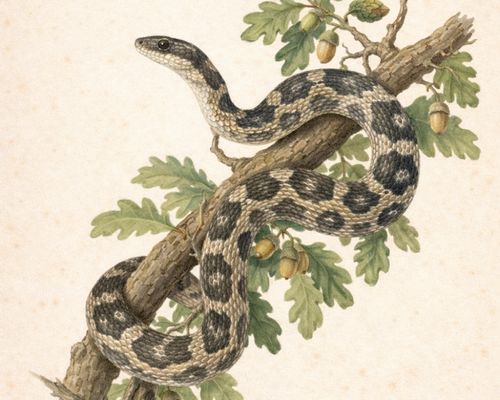
(Pantherophis obsoletus)
Venomous? No
Identification: One of the longest snakes in Texas, reaching 3½ to 6 feet; adults usually have dark gray or black blotches (juveniles are brown) on their backs that are irregularly shaped or hexagonal, and smaller blotches on their sides; they also have a white chin and throat.
Habitat: Forests, wooded river bottoms, rocky hillsides. Excellent climbers; often found around areas near humans: trees, chicken coops or barns.
Diet & ecological role: Eats rodents, birds, eggs and occasionally lizards or frogs. Major controller of rodent populations. Helps limit agricultural and structural pests. Prey for larger predators.
From the experts: “Often called chicken snakes since they are commonly found eating chicken eggs out of coops. They are adept climbers and mainly eat mice, rats or birds.”
— Toby Hibbitts, herpetologist and professor at Texas A&M University
Coachwhip
(Masticophis flagellum)
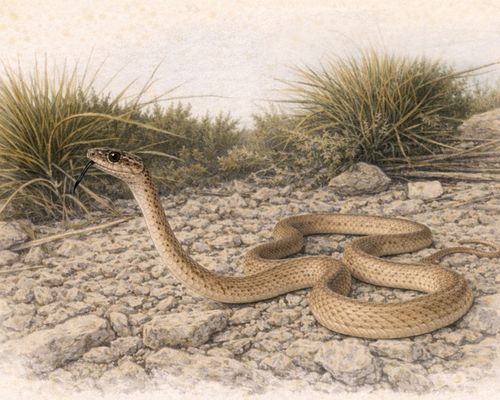
(Masticophis flagellum)
Venomous? No
Identification: This species generally reaches 4 to 5½ feet in length. It is considered one of the fastest snakes in the area, capable of speeds up to 4 mph; slender, light tan or yellowish brown in color; scales that look braided or woven; round eyes.
Habitat: Dry, open areas, including grasslands and rocky hillsides.
Diet & ecological role: Eats rodents, other snakes, lizards, insects and eggs. Helps control populations of lizards, rodents and even other snakes, including venomous species.
From the experts: “Large, fast snakes that have great vision and search for their prey during the day.”
— Toby Hibbitts
Western Ribbonsnake
(Thamnophis proximus)
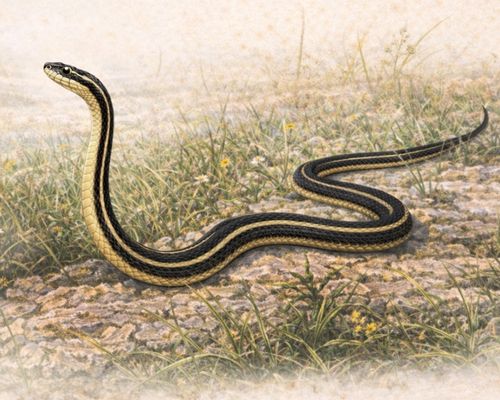
(Thamnophis proximus)
Venomous? No
Identification: Typically 20 to 30 inches long with three bright yellow stripes against a dark brown or black background color, a yellow dot on the head and a long tail. Very fast and alert.
Habitat: Wide range of habitats, typically not far from water.
Diet & ecological role: Significant predator of amphibians, but also small fish and invertebrates. Helps connect aquatic and terrestrial food webs. Prey for larger predators.
From the experts: “These guys are super-fast and excellent swimmers. Interestingly enough, they give live birth!”
— Drake Rangel, Texas Parks & Wildlife Department biologist for Fayette County
Broad-banded Copperhead
(Agkistrodon laticinctus)
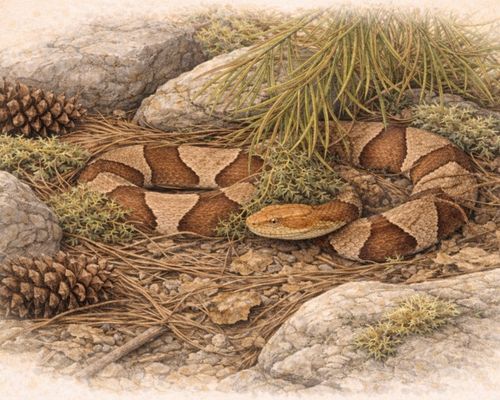
(Agkistrodon laticinctus)
Venomous? Yes
Identification: Typically 20 to 30 inches long; light brown or tan with wide or hourglass-shaped bands. Copper-colored head. Vertical pupils and heat-sensing pits, located between the eye and nostril on each side.
Habitat: Woodlands, rocky slopes, forest edges, river bottoms.
Diet & ecological role: Eats rodents, lizards, frogs and large insects (especially juveniles). Controls small mammal and insect populations. Important prey for king snakes and birds of prey.
From the experts: “Regarding copperheads, I always love to point out the ways we’ve managed to use components of their venom for medicine to include treatments for ailments such as cancer, heart problems and blood conditions.”
— Drake Rangel
Western Diamondback Rattlesnake
(Crotalus atrox)
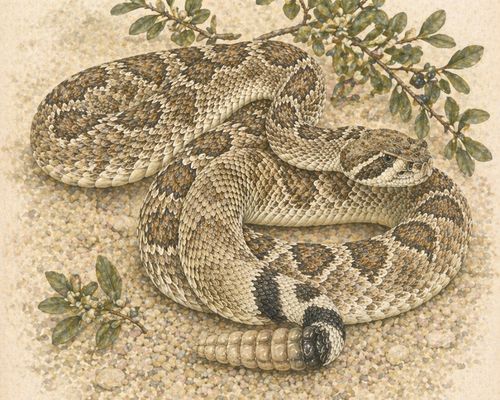
(Crotalus atrox)
Venomous? Yes
Identification: Averages 3½ to 4½ feet long and can reach 7 feet; two parallel pale stripes separated by a darker stripe extending diagonally across the cheeks to the eye; brown diamond-shaped markings down the center of its back; tails have alternating black-and-white bands and can rattle more than 60 times per second as a defensive display.
Habitat: Flatlands, prairies, rocky hills and low mountains.
Diet & ecological role: Eats rodents, rabbits and birds. Important prey for coyotes, foxes, bobcats, hawks and Texas Indigo snakes.
From the experts: “Out of all the venomous snakes around, I consider rattlesnakes to be the most polite. They are one of a few snakes with an audible sound letting you know that they are there.”
— Drake Rangel
Plain-bellied Watersnake
(Nerodia erythrogaster)
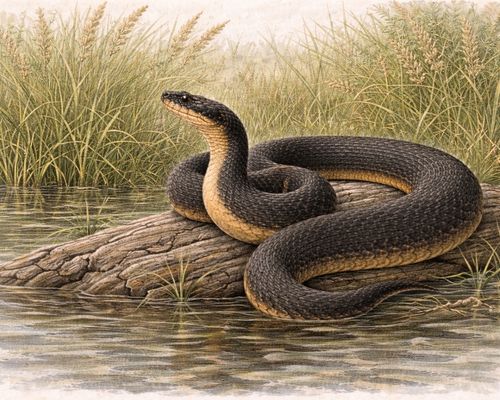
(Nerodia erythrogaster)
Venomous? No
Identification: Typically 30 to 48 inches long; mostly brown to black with blotches and a plain off-white, yellow or orange belly. Adults are often dark with faint or no pattern. Defensive when handled (flattening head and musking — the release of a strong-smelling fluid).
Habitat: Lakes, ponds, rivers, swamps and marshes.
Diet & ecological role: Eats fish, frogs, tadpoles, crayfish, invertebrates and carrion. Helps control fish and amphibian populations. Important prey for birds and mammals.
From the experts: “They are completely harmless to humans, but if harassed they will not only bite but also musk similar to a skunk! These guys are often mistaken for venomous cottonmouths almost purely due to their association with water. If you really look at them, short of being a dark-colored snake in water, they’re pretty different!”
— Drake Rangel
Brown Snake
(Storeria dekayi)
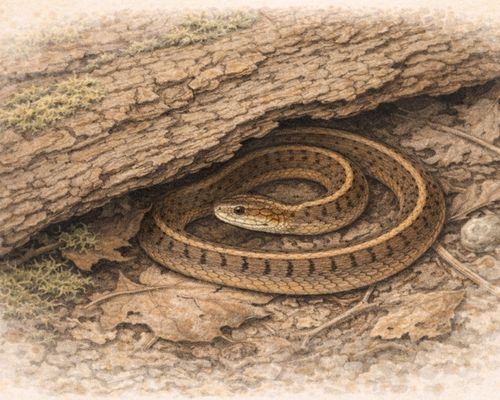
(Storeria dekayi)
Venomous? No
Identification: Usually 9 to 13 inches long; graying brown to dark brown coloring with a lighter band extending down the middle of the back; the band’s outer edges are usually lined with a row of evenly spaced small dark spots.
Habitat: Prefers wet, shaded places that offer ground cover, such as river and creek floodplains and their slopes, swamps, freshwater marshes, damp woods and even water-filled ditches.
Diet & ecological role: Eats earthworms, snails and slugs. Prey to birds, larger snakes, frogs, toads, weasels and domestic cats.
From the experts: “These snakes eat small invertebrates and are often found in leaf litter.”
— Toby Hibbitts